Career Guidance Admissions Higher Education Information
JoSAA Counselling 2026: Complete Registration, Choice Filling, Seat Allotment & Admission Guide
SA
Sameer Khan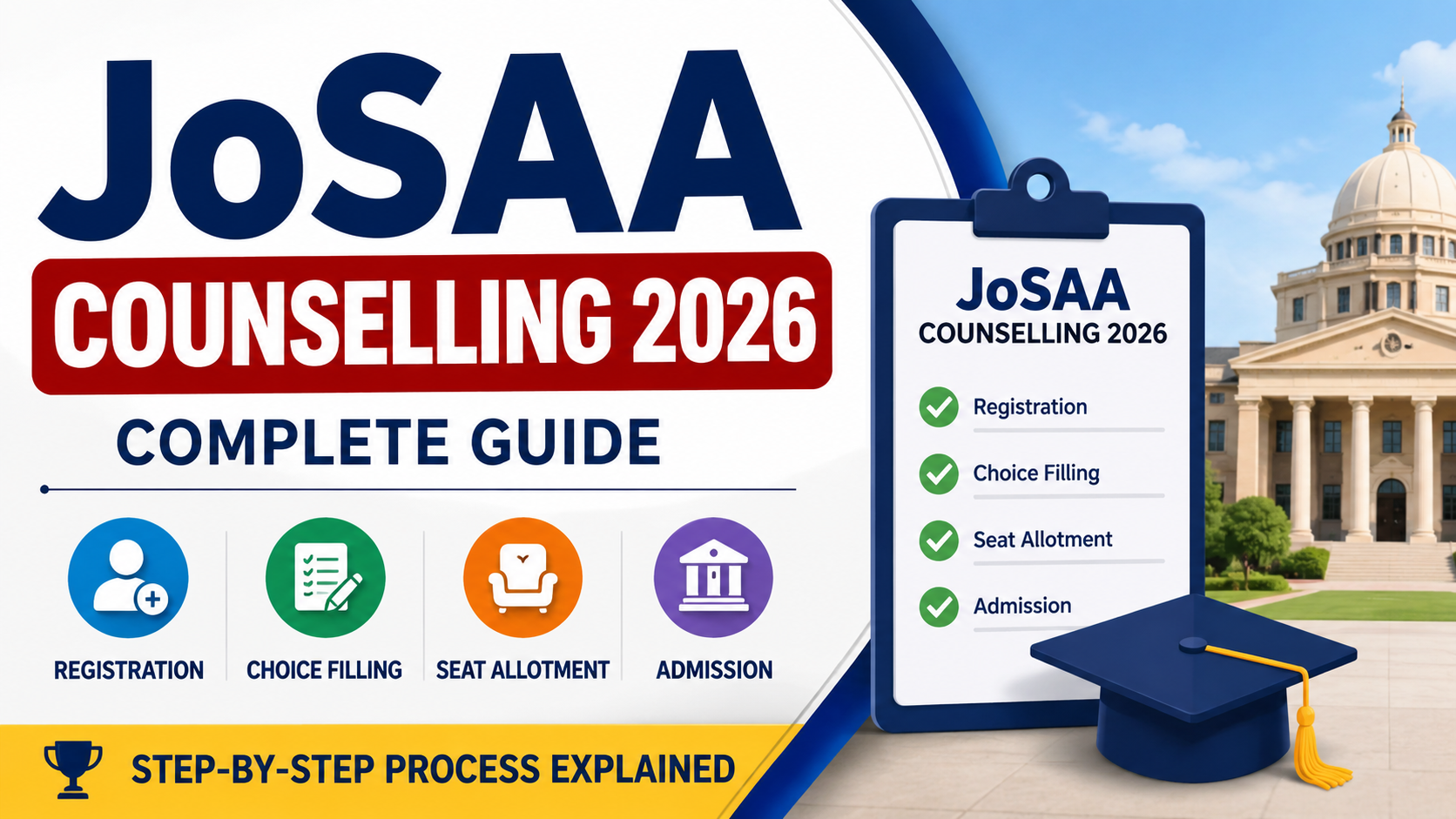
 ExamSupport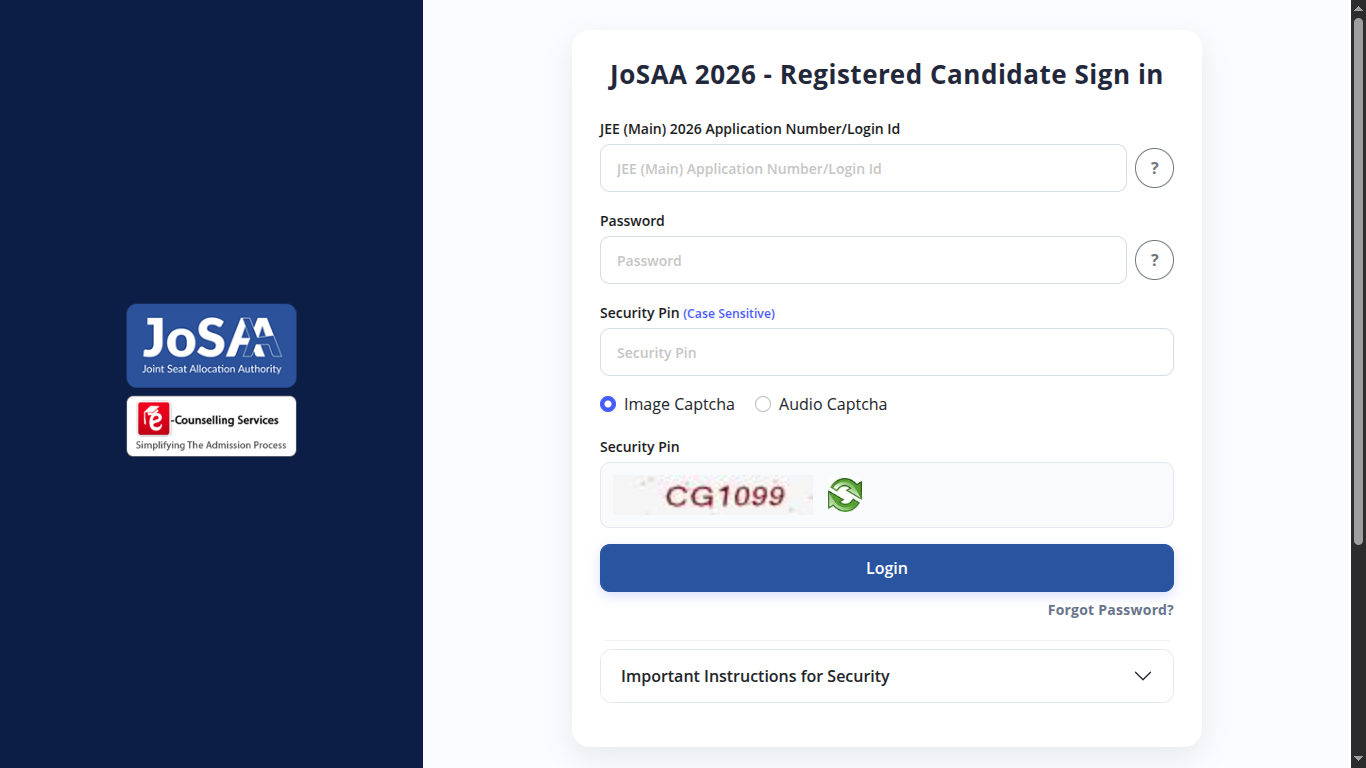
What is JoSAA? The Joint Seat Allocation Authority (JoSAA) is the centralized counselling body that manages admissions to IITs, NITs, IIITs, and GFTIs across India based on JEE Main and JEE Advanced scores.
Who can participate? Any candidate with a valid JEE Main 2026 rank can apply for NITs, IIITs, and GFTIs. JEE Advanced 2026 qualified candidates can additionally apply for IITs and IISc.
When did it begin? JoSAA Counselling 2026 registration opened on June 2, 2026, at 5:00 PM IST on the official portal josaa.nic.in.
How many rounds? There are 5 rounds of seat allotment in JoSAA 2026, plus 2 mock allotment rounds before the official process begins.
Key deadline: Registration and choice filling closes on June 11, 2026, at 5:00 PM. Do not miss this deadline under any circumstance.
Round 1 result: The first seat allotment result is announced on June 13, 2026, at 10:00 AM IST.
Critical tip: Fill as many choices as possible in your order of genuine preference. The system automatically locks your last-saved order if you miss the locking deadline.
JoSAA Counselling 2026 is now officially underway. With JEE Advanced 2026 results declared on June 1, 2026, and registration opening the very next day, the race for India's most coveted engineering seats has entered its most critical phase. If you are a JEE Main or JEE Advanced qualified candidate — or a parent or counselor guiding one — this guide is the most detailed resource you will find on how the entire process works, what to do at every step, and how to make the smartest decisions to secure the best possible seat.
JoSAA Counselling 2026 determines who gets admitted to the Indian Institutes of Technology (IITs), National Institutes of Technology (NITs), Indian Institutes of Information Technology (IIITs), and Government Funded Technical Institutes (GFTIs) across the country. Every year, hundreds of thousands of candidates qualify for JEE Main and JEE Advanced, but only a fraction understand the counselling process deeply enough to make the most of their rank. Poor strategy during choice filling, missing a reporting deadline, or not understanding the Float and Slide options can cost a student a significantly better seat.
This guide walks you through every stage — from registration on josaa.nic.in to the final admission — in plain language, with real examples, expert strategy, and verified information drawn from official JoSAA 2026 announcements. Read it fully. Return to it at each stage of the process. Your rank got you this far; your strategy will determine the rest.
JoSAA stands for the Joint Seat Allocation Authority. It is a centralized body established by the Ministry of Education, Government of India, to conduct seat allocation for undergraduate engineering and technology programmes across India's premier centrally funded technical institutions.
Before JoSAA was introduced, IITs conducted their own separate counselling, and NITs, IIITs, and GFTIs used a different system called CSAB. This created confusion, duplication, and seat-blocking — a situation where a candidate would hold seats in multiple institutions while others remained unable to get any seat. JoSAA was introduced to solve exactly this problem through a unified, merit-based, and transparent centralized allocation mechanism.
JoSAA was established jointly by the IIT Council and the NIT Council under the aegis of the Ministry of Education. It operates under a well-defined set of rules that govern eligibility, seat matrix, category-wise reservations, choice filling, allotment logic, and reporting. The authority conducts counselling using JEE Main ranks for NITs, IIITs, and GFTIs, and JEE Advanced ranks for IITs and IISc.
The official website of JoSAA is josaa.nic.in, which is hosted and managed by the National Informatics Centre (NIC) on behalf of JoSAA. All official communications, schedules, seat matrices, allotment results, and notices are published exclusively on this portal.
JoSAA is perhaps the single most consequential process in an engineering aspirant's academic journey. The seat you receive through JoSAA will shape your next four to five years of education, your career trajectory, your professional network, and in many cases, your lifetime earnings potential. Understanding JoSAA deeply is therefore not optional — it is essential.
JoSAA 2026 facilitates admissions to over 118 centrally funded premier technical institutions across India. These fall into four broad categories. The exact list and seat matrix are published on josaa.nic.in. Below is an overview based on official data and prior-year trends.
Category | Number of Institutes (Approx.) | Admission Route | Degree Types |
|---|---|---|---|
Indian Institutes of Technology (IITs) | 23 IITs + IISc Bangalore | JEE Advanced rank only | B.Tech, B.S., Dual Degree (B.Tech + M.Tech), B.Arch (with AAT) |
National Institutes of Technology (NITs) | 31 NITs | JEE Main rank | B.Tech, B.Arch, B.Plan |
Indian Institutes of Information Technology (IIITs) | 26 IIITs | JEE Main rank | B.Tech, B.E., Dual Degree |
Government Funded Technical Institutes (GFTIs) | 38+ GFTIs | JEE Main rank | B.Tech, B.E., B.Arch, B.Plan |
Some of the most prominent IITs participating in JoSAA 2026 include IIT Bombay, IIT Delhi, IIT Madras, IIT Kanpur, IIT Kharagpur, IIT Roorkee, IIT Hyderabad, IIT Gandhinagar, IIT Guwahati, IIT Jodhpur, IIT Bhubaneswar, IIT Indore, IIT Mandi, IIT Patna, IIT Ropar, IIT Tirupati, IIT Palakkad, IIT Dharwad, IIT Bhilai, IIT Goa, IIT Varanasi (IIT BHU), IIT ISM Dhanbad, and IIT Jammu. IISc Bangalore also participates for B.S. programme admissions.
Major NITs include NIT Trichy, NIT Warangal, NIT Surathkal, NIT Calicut, NIT Rourkela, NIT Durgapur, NIT Allahabad (MNNIT), NIT Jaipur (MNIT), NIT Nagpur (VNIT), and others spread across all states.
GFTIs include institutions such as IIEST Shibpur, Sant Longowal Institute (SLIET), SPA Delhi, NIT Agartala, Central University institutions, and various other Government-supported technical institutions. The complete and verified list is available at josaa.nic.in.
Important: Candidates must always verify the current seat matrix and institute list on the official JoSAA portal, as the list of participating institutes and available branches can change each year.
The eligibility requirements differ based on whether a candidate wishes to seek admission to IITs or to the NIT+ system (NITs, IIITs, GFTIs). Meeting the eligibility threshold is non-negotiable — candidates who do not meet the criteria will be rejected at the document verification stage.
The candidate must have a valid rank in JEE Advanced 2026.
The candidate must have appeared in both Paper 1 and Paper 2 of JEE Advanced 2026.
The candidate must have passed Class 12 (or equivalent) with at least five subjects, including Physics, Chemistry, and Mathematics.
General/OBC-NCL/EWS candidates must have secured at least 75% aggregate marks in Class 12 (or equivalent), or must be in the top 20 percentile of their respective board in the general category.
SC, ST, and PwD candidates need a minimum of 65% aggregate marks in Class 12 (or equivalent), or must be in the top 20 percentile of their board.
Candidates must not have accepted admission to an IIT in any earlier year (unless they are applying under a different category with improved JEE Advanced rank as per applicable rules).
Architecture Aptitude Test (AAT) qualification is required for B.Arch admissions at IITs.
The candidate must have a valid rank in JEE Main 2026 Session 1 or Session 2.
General/OBC-NCL/EWS candidates must secure at least 75% aggregate marks in Class 12 (or equivalent), or be in the top 20 percentile of their board.
SC, ST, and PwD candidates must secure at least 65% aggregate marks in Class 12.
Physics and Mathematics must be among the qualifying subjects in Class 12.
For B.Arch admissions at NITs, a valid NATA score or JEE Paper 2 (B.Arch) rank is required in addition to eligibility above.
The candidate must have a valid JEE Main 2026 rank.
The same Class 12 percentage criteria apply as for NIT admissions (75% for General/OBC-NCL/EWS; 65% for SC/ST/PwD).
Physics and Mathematics are compulsory qualifying subjects.
Some IIITs may have additional programme-specific eligibility requirements — check the IIIT's official website.
The candidate must have a valid JEE Main 2026 rank.
The same Class 12 percentage criteria apply.
Some GFTIs may have specific eligibility norms beyond the standard JoSAA requirement — candidates should verify on the individual GFTI portal.
Note: The Class 12 board percentage requirement is computed on the aggregate of the five qualifying subjects. The top 20 percentile criteria is board-specific and is calculated by JoSAA based on data provided by the respective boards. Candidates must verify their eligibility against official JoSAA and IIT Council notifications before participating.
The JoSAA 2026 official schedule has been released on josaa.nic.in. The following dates are based on the official schedule published by JoSAA. Candidates must independently verify all dates from the official JoSAA portal, as schedules can be updated without prior notice.
Event | Date / Deadline | Status |
|---|---|---|
JEE Advanced 2026 Result Declaration | June 1, 2026 | Completed |
JoSAA 2026 Registration & Choice Filling Opens | June 2, 2026 (5:00 PM IST) | Active |
AAT Choice Filling Begins (for B.Arch at IITs) | June 7, 2026 (after AAT result) | Tentative |
Mock Allotment Round 1 | June 8, 2026 | Official |
Mock Allotment Round 2 | June 10, 2026 | Official |
Choice Filling & Registration Closes | June 11, 2026 (5:00 PM IST) | Critical Deadline |
Round 1 Seat Allotment Result | June 13, 2026 (10:00 AM IST) | Official |
Round 1 Online Reporting Window (Fee + Documents) | June 13 to June 26, 2026 (5:00 PM) | Official |
Round 2 Seat Allotment Result | June 30, 2026 | Official |
Round 3 Seat Allotment Result | July 3, 2026 | Official |
Round 4 Seat Allotment Result | Tentative — approx. July 7–9, 2026 | Tentative |
Withdrawal Window (IIT/IISc) Closes | End of Round 4 (approx. July 14, 2026 at 5:00 PM) | Tentative |
Round 5 Seat Allotment Result (Final for IITs/IISc) | July 16, 2026 | Official |
JoSAA Process Concludes | July 21, 2026 | Official |
Partial Admission Fee (PAF) for NIT+ Candidates via CSAB | July 22 to July 24, 2026 (5:00 PM IST) | Official |
Disclaimer: Dates for Rounds 4 and 5 reporting windows and withdrawal deadlines are based on the official JoSAA schedule pattern and available announcements. Candidates must confirm exact sub-event timings from the official JoSAA website at josaa.nic.in, as round-specific schedules may be updated after seat allotment results for each round are announced.
The JoSAA counselling process is entirely online and follows a structured sequence of nine major steps. Missing any step, or completing it incorrectly, can result in seat forfeiture or disqualification. Here is everything you need to do, explained in detail.
What happens: Candidates create their login credentials on josaa.nic.in using their JEE Main application number (for NIT+ system) or JEE Advanced application number (for IIT system) along with their date of birth. Both JEE Main and JEE Advanced candidates use the same portal for registration.
What you should do: Go to josaa.nic.in immediately. Click on the registration link. Enter your JEE Main or JEE Advanced application number and date of birth. Set a secure password. Verify your mobile number and email ID as OTPs are sent for verification. Upload your photograph (JPEG, maximum 80KB) and signature (JPEG, maximum 30KB) in the prescribed format.
Common mistakes: Uploading a blurred photograph, entering an incorrect date of birth, or not verifying the mobile number, which prevents login for subsequent steps.
Expert advice: Register on Day 1 itself — June 2, 2026. Do not wait for the last few days. Technical issues and server load are common near deadlines. Once you register, take a screenshot of your login credentials and save them securely.
What happens: After logging in, candidates can search for and add institute-branch combinations (called choices) to their preference list. The choice filling portal shows all participating institutes, available branches, seat types, and category-wise opening/closing ranks from previous years.
What you should do: Research institutes and branches thoroughly before sitting down to fill choices. Add as many choices as possible — there is no upper limit and more choices increase your probability of getting an allotment. Arrange choices strictly in the order of your genuine preference, from most preferred to least preferred.
Common mistakes: Adding too few choices (the most dangerous mistake), arranging choices randomly without a strategy, and copying someone else's list without considering your own rank and category.
Expert advice: Spend multiple sessions on choice filling over the 10-day window. Use JoSAA's previous-year opening and closing ranks to identify realistic, aspirational, and safe choices. More on this in the Choice Filling Strategy section below.
What happens: Before the choice filling deadline (June 11, 2026, 5:00 PM), candidates must lock their choices. Locking finalizes the order in which JoSAA's algorithm will try to allot you a seat. Once locked, choices cannot be changed.
What you should do: Review your final list carefully before locking. Ensure the most preferred choice is at position 1, the second most preferred at position 2, and so on. Click the Lock button only when you are fully satisfied with your list.
Common mistakes: Locking prematurely without reviewing the list, or failing to lock at all — in which case the system auto-locks your last-saved list at the deadline. This auto-lock may not reflect your final intended preference order.
Expert advice: Do a final review of your choice list after Mock Allotment Round 2 (June 10). If the mock result reveals that you are likely to get a better option than expected, or worse, adjust your list accordingly before the June 11 deadline.
What happens: JoSAA conducts two Mock Allotment rounds — on June 8 and June 10, 2026 — using the choices filled by all candidates up to that point. The mock result is not binding but shows approximately which seat a candidate would be allotted based on their rank, category, and current choice list.
What you should do: Log in on June 8 and again on June 10 to check your mock allotment result. If you are unsatisfied with the mock-allotted seat, revise your choice order before the June 11 deadline.
Common mistakes: Ignoring the mock allotment results and failing to revise choices when there is still an opportunity to do so.
Expert advice: The mock allotment is one of the most underutilized tools in JoSAA. Use it as a diagnostic test. If Mock 1 shows you getting a seat you are unhappy with, that means your higher-ranked choices are competitive — either adjust expectations upward or add more realistic safe choices.
What happens: Starting June 13, 2026, JoSAA announces the official Round 1 seat allotment result. The algorithm assigns the highest-ranked choice (from your locked list) for which a seat is available in your rank and category. Rounds continue through July 21, 2026, with each successive round redistributing seats as candidates accept, upgrade, or withdraw.
What you should do: Log in to josaa.nic.in immediately after each round's allotment result is announced. Check whether you have been allotted a seat. Download the Provisional Seat Allotment Letter from your dashboard.
Common mistakes: Not checking the result on time, assuming no allotment means exclusion from future rounds, or panicking and withdrawing without understanding the Float option.
What happens: After receiving a seat allotment in any round, the candidate must pay the Seat Acceptance Fee (SAF) within the round's reporting window to confirm their seat. Non-payment results in automatic cancellation of the allotted seat.
What you should do: Pay the fee immediately after downloading the allotment letter. Do not wait for the last day. Use net banking, UPI, debit card, or credit card as accepted by the portal. Keep the payment receipt as proof.
Common mistakes: Delaying payment assuming there is plenty of time, and then facing a technical failure or bank issue near the deadline.
Expert advice: The seat acceptance fee is refundable (minus a processing fee) if you withdraw before the final round for your system (IIT or NIT+). Paying the fee is not a final commitment — it is the entry ticket to participate in future upgrade rounds.
What happens: After paying the SAF, candidates must upload scanned copies of all required documents within the reporting window. Documents are verified online by the allotted institute's nodal officers.
What you should do: Keep all documents scanned and ready before Round 1 (June 13, 2026). Upload clearly legible scans in the prescribed format and size. Ensure category certificates (OBC-NCL, EWS) are for the current financial year as required.
Common mistakes: Uploading blurred or incorrect documents, uploading documents in wrong format, or uploading an outdated OBC-NCL certificate that is not for the current financial year.
Expert advice: Prepare a document checklist (see the Documents section below) and scan all originals in advance. Organize them in a labeled folder on your device. Do not scan documents using a phone camera in poor lighting — use a scanning app with good quality settings.
What happens: Nodal officers at the allotted institute review the uploaded documents online. If documents are found to be correct, the candidate's online reporting is marked complete. If any document is found deficient, the candidate may receive a query and must respond within the stipulated time.
What you should do: Log in regularly to check your online reporting status. If any document query is raised, respond immediately with the corrected document. Do not ignore query notifications sent to your registered email or mobile number.
Common mistakes: Not checking the portal for queries, and missing the response deadline, which can result in seat cancellation.
What happens: After all JoSAA rounds are complete, candidates with allotted and confirmed seats must visit the physically allotted institute for final admission formalities. IIT candidates undergo biometric verification at their allotted institute. NIT+ system candidates complete the Partial Admission Fee (PAF) payment through the CSAB portal (July 22–24, 2026) before proceeding to physical reporting as per the institute's schedule.
What you should do: Carry all original documents and their self-attested photocopies to the institute. Carry the Provisional Seat Allotment Letter, fee payment receipt, and all uploaded documents in their original form.
Common mistakes: Forgetting original documents, not carrying sufficient photocopies, or not paying the PAF within the CSAB deadline (July 22–24), which forfeits the NIT+ seat.
Choice filling is the single most important action you will take during JoSAA Counselling 2026. Your choices, arranged in your preferred order, are what the JoSAA algorithm uses to determine your seat. Understanding how to build a strong, strategically ordered choice list is the difference between a satisfying outcome and a disappointing one.
The Core Principle: JoSAA's algorithm scans your locked choice list from the top (Choice 1) downwards. It allots you the highest-ranked choice in your list for which a seat is available in your rank, category, and any applicable sub-category. If Choice 1 is not available but Choice 7 is, you get Choice 7. The algorithm does not skip and come back — it processes your list in strict sequential order.
Three Tiers of Choices You Should Fill:
Dream choices (Top 20–30% of your list): These are choices where your rank is slightly beyond last year's closing rank. Include them because counselling data fluctuates year to year. Some years, branches open up significantly. Do not treat last year's cutoff as an absolute ceiling — it is a reference, not a rule.
Realistic choices (Middle 40–50% of your list): These are choices where your rank comfortably falls within the historical opening-to-closing range. These are your most likely allotments and should form the bulk of your list. Prioritize them thoughtfully — a realistic choice you genuinely love should rank higher than a dream choice you are indifferent to.
Safe choices (Bottom 20–30% of your list): These are choices where your rank is far above last year's opening rank, meaning you are almost certain to get the seat. Do not omit them — they are your safety net. Even if they are less preferred, having a confirmed admission is better than getting nothing because your safe options were too few.
Branch vs. College Decision: This is a deeply personal choice. If you prefer a specific branch (say, Computer Science) and are willing to compromise on institute reputation to get it, rank all CSE options from best-to-less-preferred institute first, then fill other branches. Conversely, if institution prestige, location, and peer network matter more to you than the branch, arrange by institute name rather than branch. Most experienced counselors recommend a hybrid approach — prefer top branches in top institutes, but do not sacrifice a great branch at a slightly lower institute for a poor branch at a marginally higher-ranked one.
Practical Example: Suppose your JEE Main rank (General category) is 8,000. Based on previous years, your realistic options might include CSE at NIT Raipur, ECE at NIT Durgapur, and Mechanical at NIT Trichy. You might want to dream for ECE at NIT Warangal or even CSE at NIT Patna. As safe choices, you might include Civil Engineering at lesser-known NITs where AIR 8000 comfortably falls in the opening range. Fill all of these. Do not restrict yourself to 10–15 choices. Candidates with 50–100 carefully ordered choices have a significantly higher chance of a satisfying outcome.
Choice Filling Tips:
Use the JoSAA previous-year opening and closing rank data available on josaa.nic.in to guide your choices — but always account for a 10–15% fluctuation.
Do not fill the same choice twice.
Consider location, campus facilities, hostel quality, placement trends, and alumni network — not just the branch name.
Fill choices across old IITs, new IITs, top NITs, and IIITs to build a robust list if you have a JEE Advanced rank.
Modifications are allowed multiple times until the choice locking deadline — use this flexibility fully.
JoSAA 2026 conducts 5 official rounds of seat allotment. Each round follows a defined process. Understanding how rounds work helps candidates make informed decisions about whether to hold their seat, float for upgrades, or slide for a better branch within the same institute.
How the Allotment Algorithm Works:
All locked choice lists of all candidates are collected after the June 11 deadline.
JoSAA's algorithm processes every candidate's list starting from Choice 1.
It assigns each candidate the best (highest-ranked) choice for which a seat is available in their rank and category.
The algorithm operates simultaneously across all candidates, resolving conflicts by rank — the candidate with a better (lower numerical) rank gets the seat if multiple candidates prefer the same option.
After Round 1 results, candidates must confirm their seat (pay SAF, upload documents) and choose Freeze, Float, or Slide.
In Round 2, the algorithm re-runs using only the choices ranked higher than the Round 1 allotment for those who chose Float. It also allots freed-up seats from those who withdrew.
This process continues through Round 5.
Flowchart of a Round:
Round Result Announced → Candidate logs in → Views allotment letter → Pays Seat Acceptance Fee → Uploads documents → Chooses Freeze, Float, or Slide → Waits for next round result → [If Float or Slide: participates in next round] → [If Freeze: exits upgradation, waits for final admission]
Important Points About Rounds:
Rounds 1 through 4 include all participating institutes (IITs, NITs, IIITs, GFTIs).
Round 5 is the final round for IITs and IISc. After Round 5, IIT seat allotments are locked, and no further changes or upgrades are possible for IIT seats.
The NIT+ system (NITs, IIITs, GFTIs) participates through all 5 rounds. After Round 5, remaining vacant NIT+ seats go to CSAB Special Rounds.
Candidates who do not respond (do not pay SAF or do not upload documents) within a round's reporting window forfeit their allotted seat automatically. There is no reinstatement process.
A candidate who does not receive an allotment in Round 1 automatically remains in subsequent rounds — they do not need to take any action to continue participation until they receive an allotment.
After paying the Seat Acceptance Fee in any round, every candidate must choose one of three options: Freeze, Float, or Slide. This decision directly impacts whether the candidate participates in subsequent rounds and whether they have a chance to receive a better allotment. Understanding these three options thoroughly is critical.
Definition: The candidate accepts the currently allotted seat and exits the upgradation process entirely. They will not be considered in any subsequent round for a different or better seat.
When to choose Freeze: When you are completely satisfied with the allotted seat and have no desire to try for something better. Also choose Freeze in the final round (Round 5) for IITs, since there are no subsequent rounds anyway.
Benefits: Certainty. You know your final allotment and can plan college admission accordingly.
Risks: You may miss out on a significantly better seat that might have opened up in a later round due to vacancies or withdrawals by others.
Definition: The candidate accepts the currently allotted seat but remains in the pool for a potentially better seat in subsequent rounds. If a higher-ranked choice from their locked list becomes available in Round 2, 3, 4, or 5, they will be automatically upgraded to that seat. If no better seat opens up, they retain the current allotment.
When to choose Float: When you have received a reasonable allotment but still have several higher-ranked (more preferred) choices in your list that may become available as other candidates withdraw or shift. This is the recommended option for most candidates in Rounds 1 through 4.
Benefits: You keep your current seat as a safety net while remaining eligible for a better seat. There is no risk of losing your current allotment by choosing Float.
Risks: There is almost no practical downside to choosing Float over Freeze in early rounds. The only consideration is administrative — you must monitor each subsequent round result and respond within the reporting window.
Real-life example: A candidate is allotted ECE at NIT Durgapur in Round 1 but had CSE at NIT Durgapur ranked higher. By choosing Float, the candidate remains eligible to receive CSE at NIT Durgapur (or anything higher in their list) if seats open up. If nothing better opens, they continue with ECE at NIT Durgapur.
Definition: The candidate accepts the allotted seat and is eligible for upgradation, but only within the same institute. Unlike Float, which considers all higher-ranked choices (including different institutes), Slide restricts upgradation to choices within the same allotted institute.
When to choose Slide: When you are satisfied with the institute but want a better branch within the same campus. For example, you are allotted Mechanical Engineering at NIT Warangal but would prefer CSE or ECE at NIT Warangal. Choosing Slide means you will be considered only for better branches at NIT Warangal, not at any other institute.
Benefits: You stay at your preferred institute while still trying for a better programme within it.
Risks: You lose the opportunity to be considered for a potentially superior option at a different institute.
Option | Keeps Current Seat? | Eligible for Upgrade? | Upgrade Scope | Best For |
|---|---|---|---|---|
Freeze | Yes (Final) | No | None | Fully satisfied candidates or final round |
Float | Yes (retains as backup) | Yes | Any higher-ranked choice (any institute, any branch) | Most candidates in Rounds 1–4 |
Slide | Yes (retains as backup) | Yes | Higher-ranked choices within same institute only | Candidates who want a better branch at the same college |
Important: You can change from Float to Freeze between rounds, but you cannot change from Freeze to Float once you have frozen your seat. Treat the Freeze decision with full finality.
The Seat Acceptance Fee (SAF) is a mandatory payment that candidates must make upon receiving a seat allotment in any round. This fee is not a registration fee — it is a confirmation deposit that demonstrates your serious intent to accept the allotted seat. The fee is adjusted against the full admission fee when you ultimately join the allotted institute.
Category | Seat Acceptance Fee (Approx.) | Processing Fee Retained by JoSAA | Refundable Amount (on valid withdrawal) |
|---|---|---|---|
General (UR) | ₹35,000 | ₹3,000 | ₹32,000 |
EWS (Economically Weaker Section) | ₹35,000 | ₹3,000 | ₹32,000 |
OBC-NCL (Other Backward Classes – Non-Creamy Layer) | ₹35,000 | ₹3,000 | ₹32,000 |
SC (Scheduled Caste) | ₹15,000 | ₹3,000 | ₹12,000 |
ST (Scheduled Tribe) | ₹15,000 | ₹3,000 | ₹12,000 |
PwD (Persons with Disabilities) | ₹15,000 | ₹3,000 | ₹12,000 |
Refund Rules:
The SAF is refunded (minus ₹3,000 non-refundable processing fee) if the candidate withdraws from JoSAA before the commencement of the final allotment round applicable to their system (IIT or NIT+).
The SAF is generally non-refundable if the candidate is allotted a seat in the final round (Round 5) and does not join the institute, as that seat can no longer be offered to another candidate.
Refunds are processed electronically to the original payment source and typically take 7–14 working days after the withdrawal is processed.
Candidates must verify the exact fee structure from the official JoSAA 2026 information brochure available on josaa.nic.in, as amounts may be revised for the current academic year.
Prepare all documents in advance. All uploads must be in the prescribed file format (typically PDF or JPEG) and within the size limits specified by JoSAA. Have originals available for physical verification at the institute.
Document | Purpose | Who Needs It |
|---|---|---|
JEE Main 2026 Admit Card | Identity verification | All candidates |
JEE Main 2026 Scorecard / Rank Card | Proof of JEE Main rank | NIT/IIIT/GFTI applicants |
JEE Advanced 2026 Admit Card | Identity verification | IIT applicants |
JEE Advanced 2026 Rank Card | Proof of JEE Advanced rank | IIT applicants |
Class 10 Marksheet & Certificate | Date of birth proof | All candidates |
Class 12 Marksheet / Pass Certificate | Academic eligibility verification | All candidates |
OBC-NCL Certificate (Current Financial Year) | Category claim | OBC-NCL candidates only |
EWS Certificate (Current Financial Year) | Category claim | EWS candidates only |
SC Certificate | Category claim | SC candidates only |
ST Certificate | Category claim | ST candidates only |
PwD Certificate (from competent medical authority) | PwD status claim | PwD candidates only |
Passport-size Photographs (recent, white background) | Portal upload and physical reporting | All candidates |
Scanned Signature | Portal upload | All candidates |
Government-issued Photo ID Proof (Aadhaar, PAN, Passport, Voter ID) | Identity verification at physical reporting | All candidates |
Medical Certificate (Fitness) | Programme-specific requirement (e.g., Mining, Chemical) | Candidates for specific branches |
AAT Scorecard (if applicable) | B.Arch admission at IITs | IIT B.Arch aspirants |
Critical Notes on Documents:
OBC-NCL and EWS certificates must be issued for the current financial year (2025–26) and must be on the official government format with the competent authority's seal and signature. Outdated certificates will be rejected.
All category certificates must explicitly state the sub-category (e.g., OBC-NCL must explicitly mention "Non-Creamy Layer").
Scan originals — do not submit scans of photocopies.
Ensure file sizes are within JoSAA-specified limits for each document type.
JoSAA follows the reservation policy mandated by the Government of India and the IIT/NIT Councils. The following reservation percentages are standard. These are subject to official government orders and any amendments thereto.
Category | Reservation Percentage | Applicable At |
|---|---|---|
General (UR – Unreserved) | No reservation (open to all on merit) | IITs, NITs, IIITs, GFTIs |
EWS (Economically Weaker Section) | 10% | IITs, NITs, IIITs, GFTIs |
OBC-NCL (Other Backward Classes – Non-Creamy Layer) | 27% | IITs, NITs, IIITs, GFTIs |
SC (Scheduled Caste) | 15% | IITs, NITs, IIITs, GFTIs |
ST (Scheduled Tribe) | 7.5% | IITs, NITs, IIITs, GFTIs |
PwD (Persons with Disabilities) | 5% (horizontal, across all categories) | IITs, NITs, IIITs, GFTIs |
Important Notes on Reservation:
EWS reservation was introduced under the 103rd Constitutional Amendment and applies horizontally alongside other categories for the general (UR) pool.
PwD reservation is a horizontal reservation — meaning 5% of seats within each category (UR, EWS, OBC-NCL, SC, ST) are reserved for PwD candidates.
OBC-NCL candidates must fall under the Non-Creamy Layer to be eligible for OBC reservation. The Creamy Layer income threshold is currently ₹8 lakh per annum (subject to government revision).
Home State and Other State quotas apply to NIT seats, with a specific percentage of seats reserved for candidates from the state where the NIT is located.
Candidates must verify the current reservation policy from official JoSAA and Ministry of Education notifications.
Among the most-searched terms on JoSAA-related queries, Opening Rank and Closing Rank (collectively known as ORCR — Opening-Closing Rank) are the primary data points that guide choice filling decisions for every candidate.
Opening Rank: The rank of the first candidate to be allotted a particular institute-branch-category combination in a given round or year. It is typically the best (lowest numerical) rank among all candidates allotted to that specific seat.
Closing Rank: The rank of the last candidate to be allotted that same institute-branch-category combination. It represents the "cutoff" — if your rank is above (numerically higher than) the closing rank from last year, you likely did not get that seat in that year's counselling.
Why Do Cutoffs Change Each Year?
The total number of candidates and their distribution of ranks changes annually.
The number of available seats can change due to institute expansion or reduction.
Candidate preferences shift based on emerging branch trends (e.g., growing interest in AI and Data Science pushing up CSE cutoffs).
The presence or absence of a good batch of candidates in a particular category affects that category's closing rank.
How to Use ORCR Data: Use the previous 2–3 years of JoSAA ORCR data available on josaa.nic.in to identify choices where your rank falls within (or just beyond) the closing rank range. A general rule of thumb: a closing rank within 10–15% of your rank makes a choice realistic. A closing rank 20–30% better than your rank makes it a dream choice worth including. Never discard a dream choice entirely — counselling has surprises every year.
Common Misconceptions:
"The closing rank from last year is the cutoff for this year." — False. It is only a reference. Cutoffs fluctuate, sometimes significantly.
"If my rank is above the closing rank, I have no chance." — Not entirely true. If only a handful of candidates chose that option last year, the closing rank may have been higher than usual. Analyze trends across multiple years.
"Opening rank is the minimum rank required." — False. The opening rank tells you the best rank that got that seat. Your rank being worse than the opening rank does not prevent you from getting it if others with better ranks did not fill that choice.
Many candidates confuse JoSAA and CSAB, or do not fully understand when CSAB becomes relevant. Here is a comprehensive comparison.
Parameter | JoSAA | CSAB |
|---|---|---|
Full Form | Joint Seat Allocation Authority | Central Seat Allocation Board |
Purpose | Main counselling for IITs, NITs, IIITs, GFTIs | Special rounds for NIT+ vacant seats after JoSAA |
Institutes Covered | IITs, IISc, NITs, IIITs, GFTIs | NITs, IIITs, GFTIs only (not IITs) |
Eligibility | JEE Main or JEE Advanced qualified | JEE Main qualified; DASA for NRI/OCI/PIO/Foreign Nationals |
When It Happens | June–July 2026 | After JoSAA (typically August 2026) |
Registration Required | Yes, on josaa.nic.in | Yes, fresh registration on csab.nic.in (separate from JoSAA) |
Seat Types | Regular seats across all allotment rounds | Only vacant seats remaining after JoSAA |
Choice Carry-forward | Not applicable | JoSAA choices do not carry forward; fresh choices required |
IIT Seats | Yes, through JEE Advanced rank | No IIT seats available in CSAB |
Number of Rounds | 5 official rounds + 2 mock rounds | Typically 2 special rounds |
Fee Structure | No registration fee; SAF paid upon seat allotment | Separate special round enrollment fee + seat acceptance |
Refund Policy | SAF refunded minus processing fee (if withdrawn before final round) | Processing fee non-refundable; stricter refund norms |
Best Use Case | Primary admission process for all JEE-qualified candidates | Fallback for candidates who missed NIT+ allotment in JoSAA |
When Should You Register for CSAB? If you complete all 5 JoSAA rounds without receiving an acceptable seat allotment for the NIT+ system, you should register for CSAB Special Rounds. CSAB typically conducts two rounds in August on available vacant NIT/IIIT/GFTI seats. Note that CSAB registration is a completely fresh process — your JoSAA registration does not automatically carry over to CSAB.
Years of counselling experience reveal the same mistakes appearing cycle after cycle. Here are the 16 most damaging ones — and how to avoid them.
Not registering early: Delaying registration to the last 2–3 days risks technical errors and server crashes. Register on Day 1 (June 2, 2026). Fix: Register immediately after JEE Advanced results are out.
Filling too few choices: Some students fill only 10–15 choices, believing more is unnecessary. This severely reduces the probability of an acceptable allotment. Fix: Fill 50 to 100 choices wherever rank permits.
Not locking choices before the deadline: The system auto-locks the last-saved order, which may not be your intended final preference. Fix: Manually lock choices well before the June 11 deadline.
Ignoring mock allotment results: The mock allotments on June 8 and June 10 are diagnostic tools — ignoring them wastes a chance to optimize your list. Fix: Log in for both mock rounds and revise choices based on results.
Putting less-preferred options at the top: If you rank ECE at a lesser NIT above CSE at a top NIT (when you actually prefer CSE), the algorithm may allot you that lesser choice. Fix: Order choices strictly by your genuine preference, not by rank or prestige alone.
Choosing Freeze in early rounds out of panic: Freezing in Round 1 or 2 eliminates any chance of a better seat in later rounds. Fix: Choose Float in early rounds unless you are completely satisfied.
Not paying the Seat Acceptance Fee on time: Missing the reporting window results in automatic seat cancellation. Fix: Pay the SAF within 24–48 hours of the allotment result, not on the last day.
Uploading incorrect or blurred documents: Rejected documents lead to online reporting failure and potential seat cancellation. Fix: Scan all documents in good quality in advance. Use a scanner app, not just a phone camera.
Submitting an outdated OBC-NCL or EWS certificate: These must be for the current financial year (2025–26). An outdated certificate results in rejection. Fix: Obtain a fresh certificate from the competent authority before counselling begins.
Treating the previous year's closing rank as an absolute cutoff: Cutoffs change every year. Candidates with ranks slightly above last year's closing rank may get those seats in the current year. Fix: Include aspirational choices and analyze 2–3 years of ORCR data.
Not checking document query notifications: Institutes raise queries on uploaded documents through the portal and registered email. Ignoring these can cancel the seat. Fix: Check the JoSAA portal and registered email daily during the counselling period.
Withdrawing prematurely: Some candidates withdraw after Round 1 or 2 out of impatience, losing the chance for upgrades in later rounds. Fix: Do not withdraw unless you have a confirmed admission elsewhere that is clearly superior.
Not planning for CSAB as a backup: Candidates who are not allotted a suitable seat in JoSAA sometimes miss CSAB registration deadlines too. Fix: Monitor CSAB dates from early July. Keep documents and fees ready for CSAB registration if JoSAA rounds do not yield the desired result.
Confusing Slide with Float: Students sometimes choose Slide when they actually want any upgrade across all institutes (Float). Fix: Read the definitions carefully. If you want any better seat anywhere, choose Float, not Slide.
Not carrying originals to physical reporting: Institute reporting requires originals, not photocopies. Missing originals can delay or deny final admission. Fix: Prepare a checklist of originals and carry them all to reporting.
Not paying the CSAB Partial Admission Fee (PAF): NIT+ candidates who receive a final allotment must pay the PAF via CSAB (July 22–24, 2026) to confirm the seat. Missing this payment forfeits the allotted seat permanently. Fix: Mark the PAF deadline prominently in your calendar and set multiple reminders.
Getting the best possible seat through JoSAA 2026 is part luck, part preparation, and a large part strategy. Here is a professional counselor's playbook for maximizing your outcome.
1. Understand Your Rank Position Precisely
Before anything else, know exactly where your rank stands in the national landscape. Use JoSAA's previous-year ORCR data to identify which institutes and branches your rank realistically qualifies for. Separate these into three tiers: reach (10–20% above last year's closing rank), core (within the historical range), and safe (well within the opening rank range).
2. Fill Choices Strategically, Not Randomly
Build your choice list like an investment portfolio — diversified across reach, core, and safe options. Start with your absolute dream choices, then work systematically downward through your tiers. Every time you add a choice, ask: "Would I genuinely be happy studying here for 4 years?" If not, either move it lower in your list or exclude it entirely.
3. Always Choose Float in Early Rounds
There is virtually no benefit to choosing Freeze in Rounds 1, 2, or 3 unless you have been allotted your top dream choice. Float costs you nothing but keeps the door open for upgrades. In the counselling world, keeping options open is always preferable to closing them prematurely.
4. Use Slide When Branch Matters More Than Institute
If you are in a situation where you are allotted Mechanical at NIT Warangal and your next higher choice is CSE at NIT Warangal (not another institute), Slide can be the perfect option. However, if you also have higher-ranked choices at NIT Trichy or NIT Surathkal, Float is better.
5. Monitor the Seat Matrix After Each Round
After each round's allotment, JoSAA publishes updated seat availability data. Analyze which branches at which institutes saw significant movement (many candidates moving in or out). This gives you a real-time sense of what is likely available in the next round.
6. Think Beyond Prestige — Think Fit
IIT Roorkee vs. NIT Trichy is not a simple comparison. Location, cost of living, alumni network, research culture, placement in specific sectors, campus life — all matter. Many graduates from NITs outperform IIT graduates in specific industries. Make choices based on fit, not just nameplate value.
7. Have a Clear Decision Rule for Each Round
Before Round 1 results, decide: "If I get X or better, I will Freeze. Otherwise, I will Float." This pre-commitment prevents emotional decision-making in the stressful hours after the result is announced. Write it down. Share it with a parent or mentor.
8. Do Not Ignore New IITs
New IITs (post-2008 establishments) are often underestimated in terms of placement potential and campus development. With the IIT brand, facilities are improving rapidly. A CSE or ECE seat at a newer IIT may yield a better career outcome than an older branch in a good NIT in many cases — analyze carefully.
9. Plan Your Financials in Parallel
Understand the fee structure of every institute in your core and safe lists. Some candidates reject good allotments at the last minute because they cannot pay the semester fees on time. Research fee waiver, scholarship, and loan options for your target institutes in advance.
10. Register for CSAB as a Backup Strategy
If JoSAA rounds do not yield an acceptable outcome, CSAB Special Rounds are your next opportunity. Be ready to register on csab.nic.in immediately when CSAB opens. Keep all documents and fee funds ready. CSAB timelines are tight and miss no deadlines.
Q1: What is JoSAA and what is its full form?
JoSAA stands for Joint Seat Allocation Authority. It is the centralized body established by the Ministry of Education to conduct joint seat allocation for IITs, NITs, IIITs, and GFTIs based on JEE Main and JEE Advanced ranks.
Q2: When did JoSAA 2026 registration begin?
JoSAA 2026 registration began on June 2, 2026, at 5:00 PM IST on josaa.nic.in, one day after the JEE Advanced 2026 results were declared on June 1, 2026.
Q3: What is the last date to register and fill choices in JoSAA 2026?
The deadline for both registration and choice filling is June 11, 2026, at 5:00 PM IST. After this, no changes are possible.
Q4: How many rounds are there in JoSAA 2026?
JoSAA 2026 conducts 5 official rounds of seat allotment. Additionally, there are 2 mock allotment rounds on June 8 and June 10 before the official rounds begin.
Q5: Can a JEE Main qualified candidate get into an IIT through JoSAA?
No. IIT admissions require a valid JEE Advanced 2026 rank. JEE Main rank only qualifies a candidate for NITs, IIITs, and GFTIs. To appear in JEE Advanced, a candidate must be among the top 2.5 lakh candidates in JEE Main 2026.
Q6: What is the Seat Acceptance Fee and is it refundable?
The Seat Acceptance Fee (SAF) is approximately ₹35,000 for General/OBC-NCL/EWS candidates and ₹15,000 for SC/ST/PwD candidates. It is refundable (minus ₹3,000 processing fee) if the candidate withdraws before the final allotment round. Candidates must verify the exact amounts from josaa.nic.in.
Q7: What is the difference between Float, Freeze, and Slide?
Freeze means you accept the allotted seat and exit upgradation. Float means you accept the seat but remain eligible for any better choice in higher rounds. Slide means you accept the seat but remain eligible only for a better branch within the same institute. Float is recommended for most candidates in early rounds.
Q8: Can I change from Float to Freeze?
Yes, you can change from Float to Freeze between rounds. However, you cannot change from Freeze to Float. Once you Freeze your seat, the decision is final.
Q9: What happens if I do not pay the Seat Acceptance Fee within the reporting window?
Your allotted seat is automatically cancelled. There is no grace period or reinstatement process. You must respond within the round's reporting window without exception.
Q10: What is Mock Allotment and why is it important?
Mock allotment is a simulated seat allocation run by JoSAA on June 8 and June 10, 2026. It shows candidates an approximate result based on current choice lists and ranks, allowing them to revise their choices before the official deadline. It is an important diagnostic tool that many students underutilize.
Q11: How many choices should I fill in JoSAA?
There is no official upper limit on choices. Experienced counselors recommend filling between 50 and 100 choices in a carefully ordered list. More choices across reach, core, and safe options increases the likelihood of receiving an acceptable allotment.
Q12: Is the OBC-NCL certificate required to be of the current financial year?
Yes. OBC-NCL certificates must be for the current financial year (2025–26) and must explicitly state "Non-Creamy Layer" status. Outdated certificates will be rejected during document verification.
Q13: Can I modify my choices after locking them?
No. Once choices are locked, no modifications are possible. However, before locking, candidates can add, delete, and reorder choices as many times as they wish within the choice filling window.
Q14: What happens if I do not receive any allotment in JoSAA rounds?
Candidates who do not receive any allotment in JoSAA are eligible to participate in CSAB Special Rounds for NIT/IIIT/GFTI vacant seats. IIT seats are not available through CSAB. You must register separately on csab.nic.in.
Q15: Is there a registration fee for JoSAA 2026?
JoSAA does not typically charge a registration fee before seat allotment. The Seat Acceptance Fee is charged only after a seat is allotted. Verify current terms on josaa.nic.in.
Q16: When is Round 1 seat allotment result declared?
Round 1 seat allotment result for JoSAA 2026 is declared on June 13, 2026, at 10:00 AM IST on josaa.nic.in.
Q17: What is the last round for IIT seat allotment in JoSAA 2026?
Round 5 (scheduled around July 16, 2026) is the final and conclusive round for IIT and IISc seat allotments. There are no further rounds or spot rounds for IITs after this.
Q18: What is the Partial Admission Fee (PAF) for NIT+ candidates?
After the completion of all JoSAA rounds, NIT+ system candidates who received a final seat allotment must pay the Partial Admission Fee through the CSAB portal between July 22–24, 2026, at 5:00 PM IST. Failure to pay this fee results in permanent forfeiture of the allotted seat.
Q19: Can I withdraw from JoSAA after accepting a seat?
Yes, but with conditions. For IIT/IISc seats, withdrawal is allowed from Round 2 until the end of Round 4 only. For NIT+ system seats, withdrawal timelines differ. Withdrawal after Round 5 for IITs is not permitted. The processing fee of ₹3,000 is deducted from the refunded SAF on withdrawal.
Q20: Can I participate in JoSAA if I have already taken admission in a state engineering college?
Yes, you can participate in JoSAA even if you have provisional admission elsewhere. However, if you accept a JoSAA seat and report to the JoSAA-allotted institute, your state college admission will need to be withdrawn. Plan carefully before making this decision.
Q21: How do I check my JoSAA 2026 seat allotment result?
Log in to josaa.nic.in with your application number and password after the respective round's result announcement time. Your allotment status and the Provisional Seat Allotment Letter will be available on your dashboard.
Q22: What is DASA and how is it related to JoSAA?
DASA (Direct Admission of Students Abroad) is a special scheme for admission of foreign nationals, NRI, OCI, PIO, and CIWG category candidates to NITs, IIITs, and GFTIs. A JoSAA Special Round is also conducted in coordination with DASA Counselling 2026 for these categories.
Q23: Does JoSAA choose the institute for me, or do I choose?
You provide a ranked list of your preferred institute-branch combinations. JoSAA's algorithm allocates the best available choice from your list based on your rank, category, and seat availability. The choice is yours — JoSAA executes the allocation.
Q24: Is there a Home State quota in JoSAA?
Home State and Other State quotas exist for NIT admissions. A specific percentage of seats at each NIT is reserved for candidates who have studied Class 12 from the state in which the NIT is located. The rest are open to candidates from all states (Other State quota). This quota does not apply to IITs.
Q25: Can I apply for both IIT and NIT options in the same JoSAA registration?
Yes. If you have a JEE Advanced rank, you can fill choices for both IITs and the NIT+ system in the same JoSAA registration. The algorithm considers all your choices — if you are not allotted an IIT seat, it moves down your list to NIT/IIIT/GFTI options.
Q26: What is the Architecture Aptitude Test (AAT) and who needs to take it?
AAT is a test administered by the IITs for candidates who wish to pursue B.Arch at IITs (IIT Kharagpur and IIT Roorkee). It is separate from JEE Advanced and is usually held a few days after JEE Advanced results. Only JEE Advanced qualified candidates need to take AAT if they want B.Arch at an IIT. AAT results are typically declared within a week.
Q27: What if my documents are found deficient during online verification?
If a document query is raised by the verifying institute, you will receive a notification on your registered email and on the JoSAA portal. You must respond with the corrected or clarified document within the specified time. Failure to respond can result in rejection of your online reporting and consequent seat cancellation.
JoSAA Counselling 2026 is now active, and the window for securing one of India's most prestigious engineering seats is open. The process is entirely online, structured, and merit-driven — but the outcome depends equally on your preparation, strategy, and attention to deadlines.
To recap the essentials: register immediately on josaa.nic.in, build a comprehensive and thoughtfully ordered choice list of 50 or more options, use the mock allotment rounds on June 8 and June 10 to refine your list, lock choices before the June 11 deadline, and respond to every seat allotment announcement promptly by paying the SAF and uploading documents within the round's reporting window. Choose Float in early rounds rather than Freeze, unless you are fully satisfied with your allotment. Keep original documents ready for physical reporting at your allotted institute after the conclusion of all rounds.
For candidates targeting IITs, remember that Round 5 (around July 16, 2026) is the final and conclusive round — no upgrades or spot rounds exist for IIT seats after this. For NIT+ candidates, ensure you pay the Partial Admission Fee through the CSAB portal between July 22–24, 2026, or risk forfeiting your seat permanently.
JoSAA can seem overwhelming, but it is fundamentally a transparent and student-friendly system. The candidates who succeed are not always those with the highest ranks — they are the ones who understood the process, filled their choices wisely, and responded to every deadline without exception. You have worked hard to earn your JEE rank. Now work smart to convert that rank into the admission you deserve.
All the best for JoSAA Counselling 2026. Keep visiting josaa.nic.in for the latest official updates and notifications.
The following related articles are recommended for internal linking to improve site authority and user engagement:
JEE Main 2026 Result — Analysis, Toppers, and Cutoff Scores
JEE Advanced 2026 Result — Rank List, Toppers, and Category-wise Cutoffs
Top IITs in India 2026 — Rankings, Placements, and Admission Data
Top NITs in India 2026 — Rankings, Branches, and Closing Ranks
CSAB Counselling 2026 — Complete Guide to Special Rounds
JoSAA Opening and Closing Ranks 2025 — Year-wise Historical Data
Best Engineering Branches in India 2026 — Scope, Salaries, and Future Trends
IIT Admission Process 2026 — Eligibility, JEE Advanced, and JoSAA
NIT Admission 2026 — JEE Main Cutoffs and Home State vs. Other State Quotas
JEE Main 2026 Cutoff for JEE Advanced — Category-wise Qualifying Percentile
Official JoSAA Portal — josaa.nic.in (Joint Seat Allocation Authority)
JEE Advanced 2026 Official Website — jeeadv.ac.in (IIT Roorkee, Organizing Institute)
JEE Main 2026 Official Website — jeemain.nta.ac.in (National Testing Agency)
Ministry of Education, Government of India — education.gov.in
CSAB Official Portal — csab.nic.in (Central Seat Allocation Board)
IIT Council Admission Regulations — Official notifications from IIT admission portals
NIT Council Admission Norms — Official notifications from NIT admission portals
National Informatics Centre (NIC) — Hosting authority for josaa.nic.in and csab.nic.in
JoSAA 2026 Official Information Brochure — Available for download on josaa.nic.in
JoSAA Opening and Closing Rank Archive (2018–2025) — josaa.nic.in/ORCRRanks
About the Author
This article has been authored and reviewed by a senior education journalist and admissions expert with over 15 years of experience covering Indian engineering admissions, IIT-JEE counselling, and higher education policy. Having guided more than 10,000 JEE aspirants through JoSAA, CSAB, and state-level counselling processes, the author brings a rare combination of on-the-ground counselling experience and editorial expertise to every guide published on this platform. The author holds a Post-Graduate degree in Educational Administration and has contributed research and analysis to leading education journals, government advisory panels, and major coaching institutions across India. All information in this article is verified against official JoSAA notifications, IIT and NIT admission portals, and Ministry of Education publications before publication.