
Complete Guide to the National Defence Academy and Defence Careers
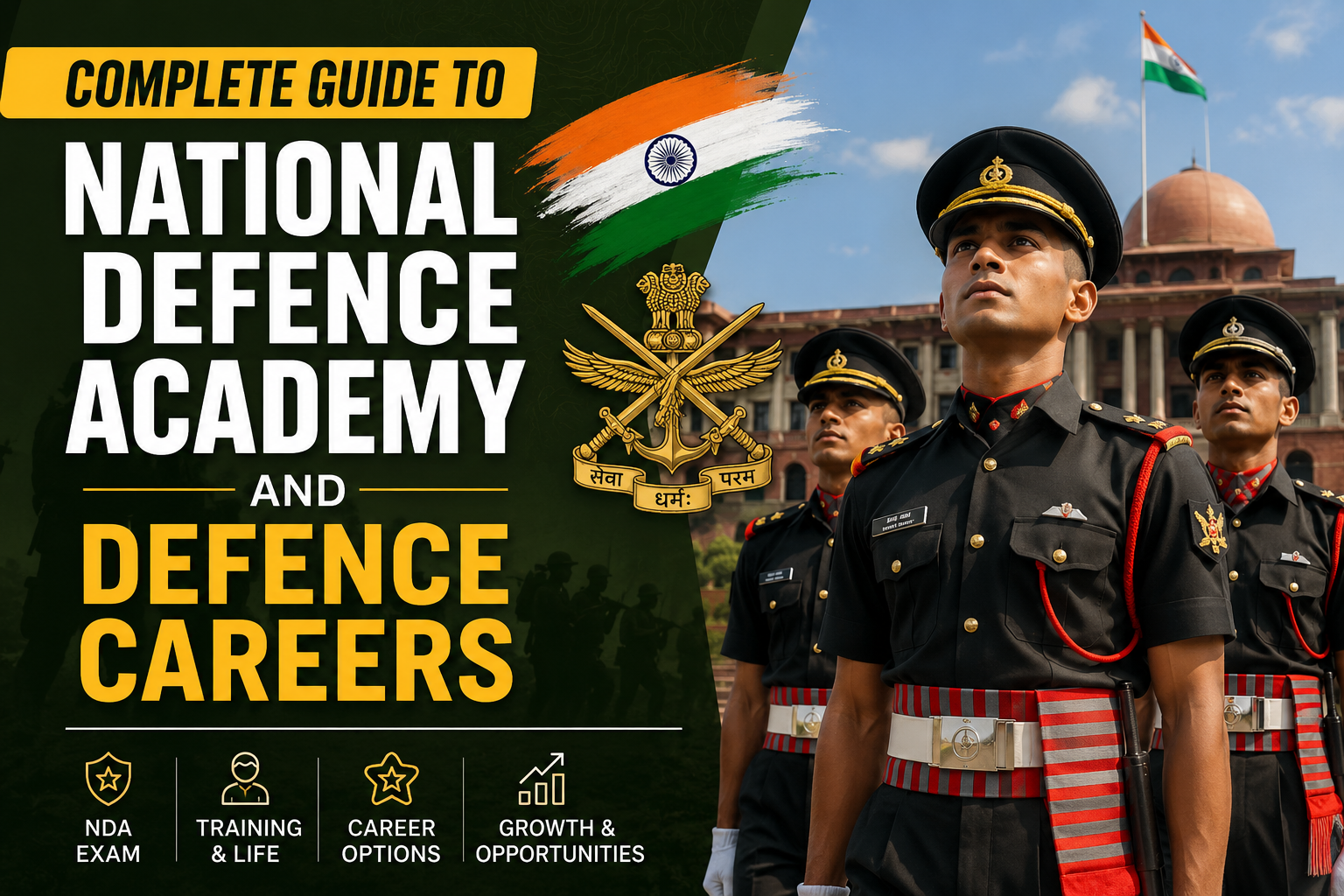
Table of Contents
Guide to National Defence Academy (NDA) Preparation and Career Opportunities
Introduction
You want to join the Armed Forces. The National Defence Academy (NDA) gives you a direct path to do exactly that. Located in Khadakwasla, Pune, the NDA trains cadets for the Indian Army, Navy, and Air Force. You undergo rigorous physical and academic conditioning before proceeding to your specific service academy. This guide breaks down the requirements, the exams, and the daily preparation you need while you are in Class 10, 11, or 12.
What is the National Defence Academy?
The NDA operates as a joint services academy. Cadets from all three branches train together for three years. You earn a Bachelor of Arts, Bachelor of Science, or Bachelor of Technology degree from Jawaharlal Nehru University (JNU) upon completion. The training focuses on physical fitness, weapon handling, map reading, and academic coursework.
After three years at the NDA, you move to your respective service academy for one final year of specialized training. Army cadets go to the Indian Military Academy in Dehradun. Navy cadets go to the Indian Naval Academy in Ezhimala. Air Force cadets go to the Air Force Academy in Dundigal.
Life at the Academy
Your life at the NDA follows a strict, minute-by-minute schedule. You are assigned to one of the 18 squadrons, which becomes your primary unit for all inter-squadron competitions in sports, debate, and academics.
A typical day starts at 04:00 AM. You report for physical training or drill by 06:00 AM. Academic classes consume your morning and early afternoon. In the late afternoon, you participate in mandatory outdoor games like hockey, football, or basketball. Evenings are reserved for self-study, weapon training, and squadron activities. Lights out is strictly enforced at 10:15 PM. You develop immense discipline, time management skills, and physical endurance through this daily routine.
Detailed Eligibility Criteria
You must meet strict age, educational, and physical requirements to qualify for the NDA.
Age and Marital Status: You must be between 16.5 and 19.5 years old when the course begins. You must be unmarried and remain unmarried until you complete your full training.
Educational Qualifications for Army: You need a Class 12 pass certificate from a recognized state board or university. You can belong to any stream, including Arts, Commerce, or Science.
Educational Qualifications for Air Force and Navy: You must pass Class 12 with Physics, Chemistry, and Mathematics.
Physical Standards: You must be physically and mentally fit according to the prescribed military standards. For the Army and Navy, the minimum acceptable height is 157 cm. For the Air Force, the minimum acceptable height is 162.5 cm. You must meet specific vision standards, which vary based on the branch you choose. Corrective eye surgery guidelines are strict. You must read the official Union Public Service Commission (UPSC) notification to verify the exact medical parameters for your chosen branch.
Nationality: You must be a citizen of India, a subject of Nepal, or a person of Indian origin who has migrated from specific countries with the intention of permanently settling in India.
Exam Pattern and Syllabus
The UPSC conducts the written examination. The exam consists of two objective-type papers held on the same day.
Mathematics (Paper 1): You get 2.5 hours to complete 120 questions. The maximum score is 300 marks. The syllabus covers Class 11 and 12 mathematics. Topics include Algebra, Matrices and Determinants, Trigonometry, Analytical Geometry, Differential Calculus, Integral Calculus, Vector Algebra, and Statistics. Every correct answer gives you 2.5 marks. Every wrong answer subtracts 0.83 marks.
General Ability Test (Paper 2): You get 2.5 hours to complete 150 questions. The maximum score is 600 marks. The GAT has two parts. Part A is English, consisting of 50 questions worth 200 marks. This tests your grammar, vocabulary, and reading comprehension. Part B is General Knowledge, consisting of 100 questions worth 400 marks. This section includes Physics, Chemistry, General Science, History, Geography, and Current Events. Every correct answer gives you 4 marks. Every wrong answer subtracts 1.33 marks.
The SSB Interview Process
If you clear the written exam cutoff, you face the Services Selection Board (SSB) Interview. This five-day evaluation process is worth 900 marks and tests your intelligence, personality, and leadership potential.
Day 1 (Screening): You take the Officer Intelligence Rating tests and the Picture Perception and Description Test. If you do not pass this screening, you are sent home the same day.
Day 2 (Psychology Tests): You complete written psychological evaluations, including the Thematic Apperception Test, Word Association Test, and Situation Reaction Test.
Days 3 and 4 (Group Testing): You participate in outdoor physical exercises and group problem-solving tasks. The Group Testing Officer assesses your ability to work within a team and lead under pressure.
Day 5 (Conference): You face the board members for a final interview, and they decide your final recommendation.
Important Dates and Application
The UPSC conducts the NDA exam twice a year.
NDA I Cycle: The notification is released in late December. You submit your application in January. The exam takes place in mid-April. As an example, the recent NDA I 2026 exam was held earlier this month.
NDA II Cycle: The notification is released in mid-May. You submit your application in June. The exam takes place in early September.
You must apply online through the official UPSC website (upsconline.nic.in). You need to register on the One Time Registration (OTR) platform before filling out the specific application form. The application fee is 100 INR for General and OBC candidates. SC, ST, and female candidates are exempt from the fee.
Concrete Preparation Tips
You need a structured approach to pass the written exam and the SSB.
Master the NCERT Books: Base your preparation on Class 11 and Class 12 NCERT textbooks for Mathematics, Physics, and Chemistry. They build the exact foundation required for the UPSC questions.
Solve Previous Year Papers: Download the last 10 years of NDA question papers. Set a timer for 2.5 hours and solve them. This trains your time management and helps you identify repeating question patterns.
Read the Newspaper Daily: Dedicate 45 minutes every day to reading a national newspaper like The Hindu or The Indian Express. Focus on national news, international relations, defense acquisitions, and sports. This prepares you for the Current Events section and gives you talking points for the SSB interview.
Improve Your Spoken English: The SSB interview involves group discussions and personal interviews conducted in English. Practice speaking clearly. Record yourself reading articles aloud or discuss current affairs with your peers in English.
Build Physical Endurance: The SSB requires physical stamina for group tasks. Start a daily routine now. Aim to run 2.4 kilometers in under 15 minutes. Practice push-ups, sit-ups, and chin-ups. A strong physical baseline prevents injuries during training and shows the assessors you are fit.
Analyze Your Mistakes: When taking mock tests, review the questions you got wrong. If you lose marks due to negative marking, practice skipping questions you do not know.
Career Opportunities and Pay Scale
Once you complete your training, you receive a commission as an officer in the Armed Forces.
Starting Ranks: You start as a Lieutenant in the Indian Army, a Sub-Lieutenant in the Indian Navy, or a Flying Officer in the Indian Air Force.
Pay Scale: The starting basic pay for these ranks sits at Level 10 of the pay matrix, which is 56,100 INR per month. You also receive various allowances, including Military Service Pay, Dearness Allowance, flying allowance for pilots, high altitude allowance, and free medical facilities for yourself and your dependents.
Responsibilities: You take on heavy responsibilities immediately. A 21-year-old Lieutenant commands a platoon of 30 highly trained soldiers in challenging terrains. You get opportunities to upgrade your skills, attend defense staff colleges, and rise through the ranks to positions like Major, Colonel, or General.
Conclusion
The National Defence Academy demands academic discipline, physical fitness, and mental toughness. The selection process is difficult and highly competitive. Start studying your syllabus thoroughly, maintain a strict physical routine, and stay updated on world events. If you commit to the preparation, you put yourself in a strong position to earn the uniform and serve as an officer in the Indian Armed Forces.